APST 1.2 · APST 3.1 · APST 3.2 · APST 4.2 · APST 5.1 · APST 5.2 · APST 5.3 · APST 5.4 · APST 5.5
Making Learning Visible Through Assessment
During my Reception placement (5–6 years), assessment was an ongoing part of teaching rather than something conducted only at the end of a unit. Before planning, I analysed existing assessment data and writing samples (TPA2) to identify students’ current literacy capabilities (refer to figure 1; APST: 5.1, 5.4). The evidence showed that many children were still transitioning from drawing to labelling and were not yet consistently writing words or complete sentences.Primary APST Focus:
APST 5.1, 5.2, 5.3
Supporting APST:
APST 3.1, 3.2,5.4,5.5
C-Context
During my Reception placement (5–6 years), assessment was an ongoing part of teaching rather than something conducted only at the end of a unit. Before planning, I analysed existing assessment data and writing samples (TPA2) to identify students’ current literacy capabilities (refer to figure 1; APST: 5.1, 5.4). The evidence showed that many children were still transitioning from drawing to labelling and were not yet consistently writing words or complete sentences.
This analysis informed the design of differentiated learning experiences and appropriate Success Criteria, ensuring that assessment aligned with students’ developmental readiness while maintaining high expectations (Black & Wiliam, 1998; EYLF V2.0, AGDE, 2022).
Evidence analysed before planning (previous writing samples and assessment data).
Annotation
Existing writing samples and assessment records were analysed to identify students’ literacy development and inform differentiated planning for subsequent learning experiences.
A-Action
Assessment was intentionally integrated into planning, teaching, feedback and reporting.
Based on the assessment evidence, I designed a developmental writing sequence that reflected students’ current capabilities rather than expecting all children to achieve the same outcome simultaneously. Learning experiences progressed from communicating ideas through drawings, to adding labels, recording individual words and eventually constructing simple factual sentences (refer to Figure 2; APST 3.1, 3.2, 5.1). This progression reflected children’s existing capabilities while providing appropriate challenge (Vygotsky, 1978).
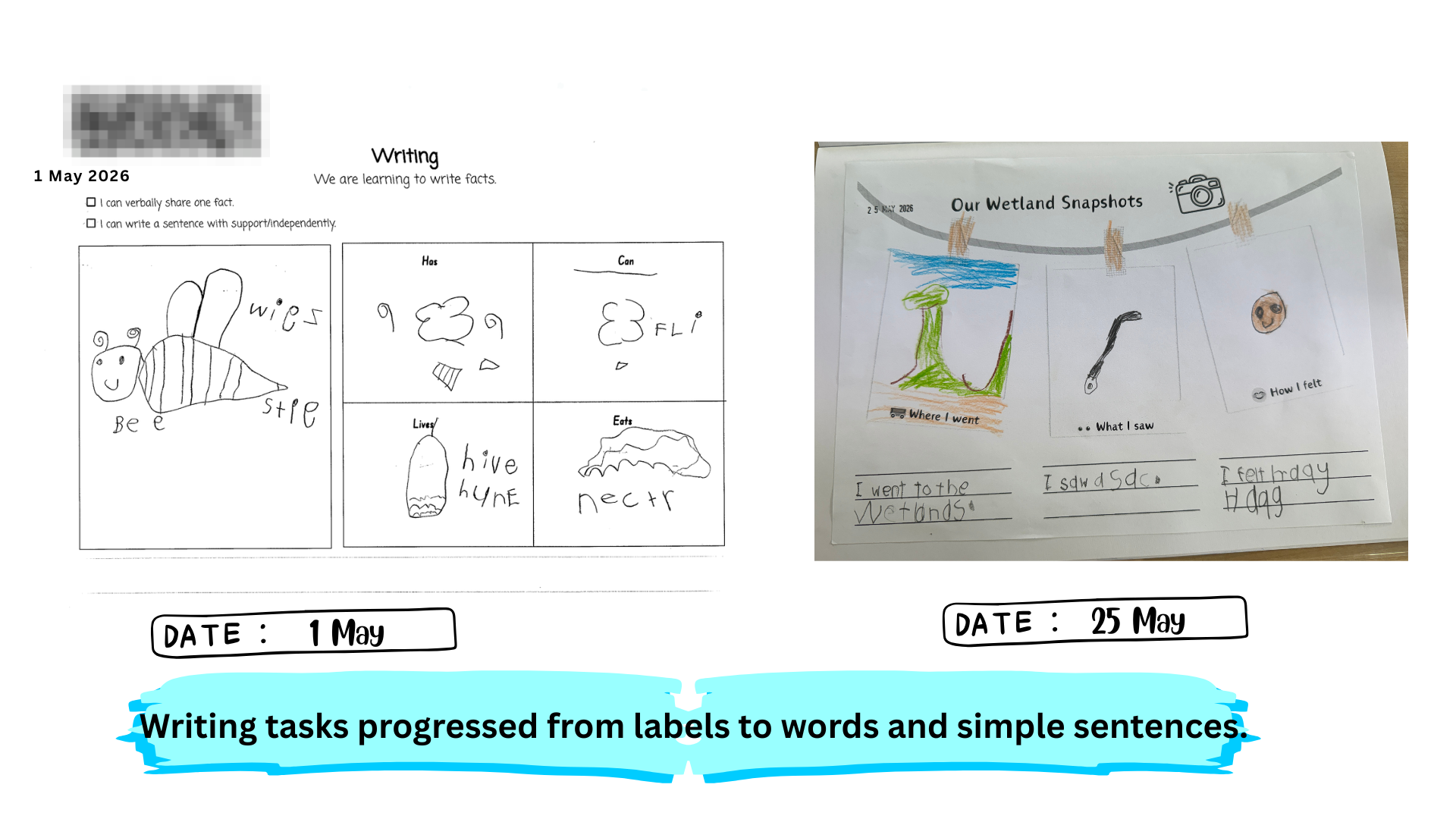
Progression of writing from drawing to labels, words and simple sentences.
Annotation
Assessment evidence informed differentiated writing instruction and learning progression.
Every lesson included clearly communicated Learning Intentions and Success Criteria, supported by pre-assessment questions, modelling and examples. These criteria provided a shared reference point for teaching and helped me gather formative evidence through observation, questioning, discussion and work samples (refer to Figure 3; Black & Wiliam, 1998).
Students’ work samples were collected as ongoing evidence of learning and informed subsequent planning.
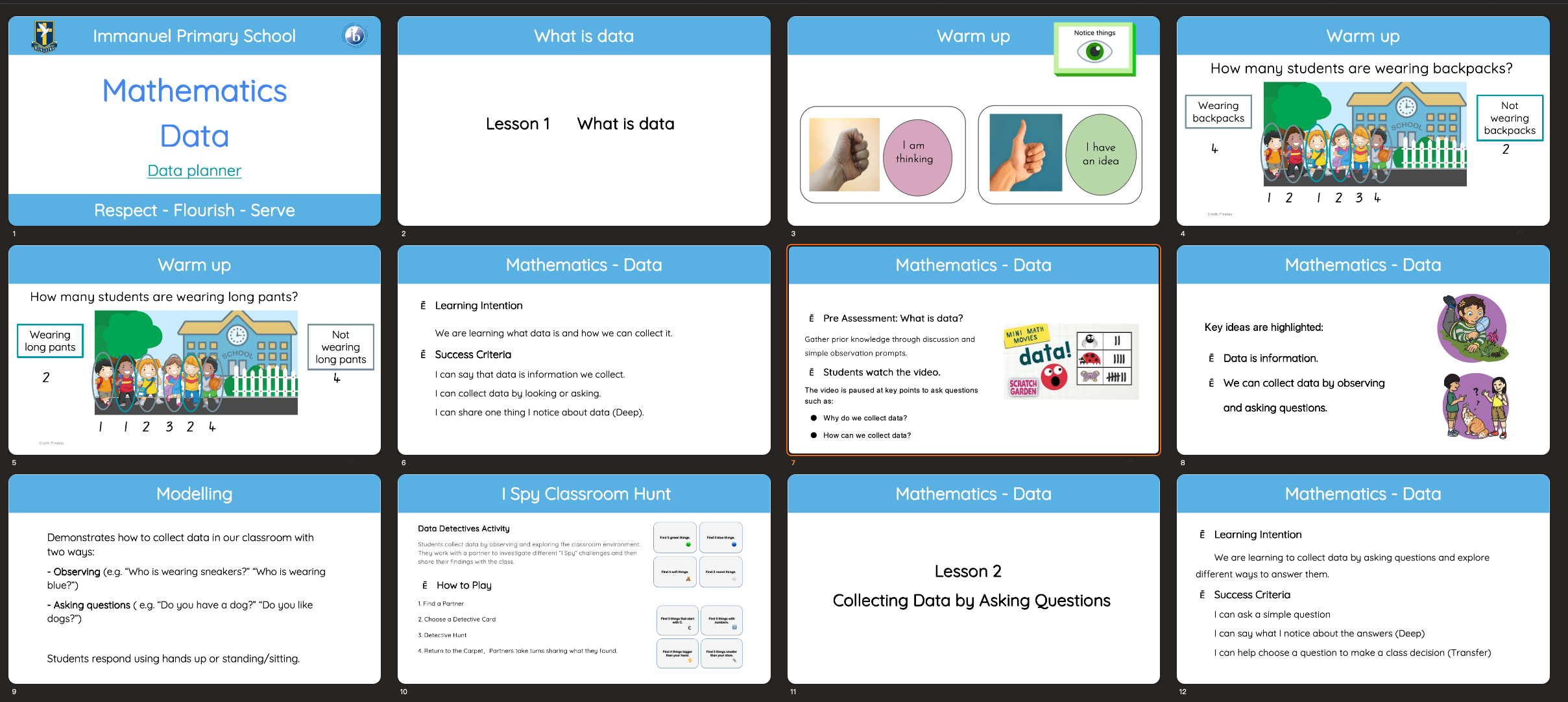
Learning Intentions and Success Criteria embedded within Mathematics lessons.
Annotation
Learning Intentions, Success Criteria and pre-assessment questions used to align teaching and formative assessment.
APST:
3.1, 5.1, 5.2
Formative assessment continued throughout learning through classroom observations, questioning, conferencing and analysis of students’ work samples. During the Mathematics Data unit, students demonstrated their understanding by sorting objects and explaining the reasoning behind their classifications. Their responses were recorded against the lesson Success Criteria, allowing misconceptions to be identified immediately and informing the level of scaffolding required during the lesson (refer to Figure 4; APST 5.1, 5.2, 5.4).
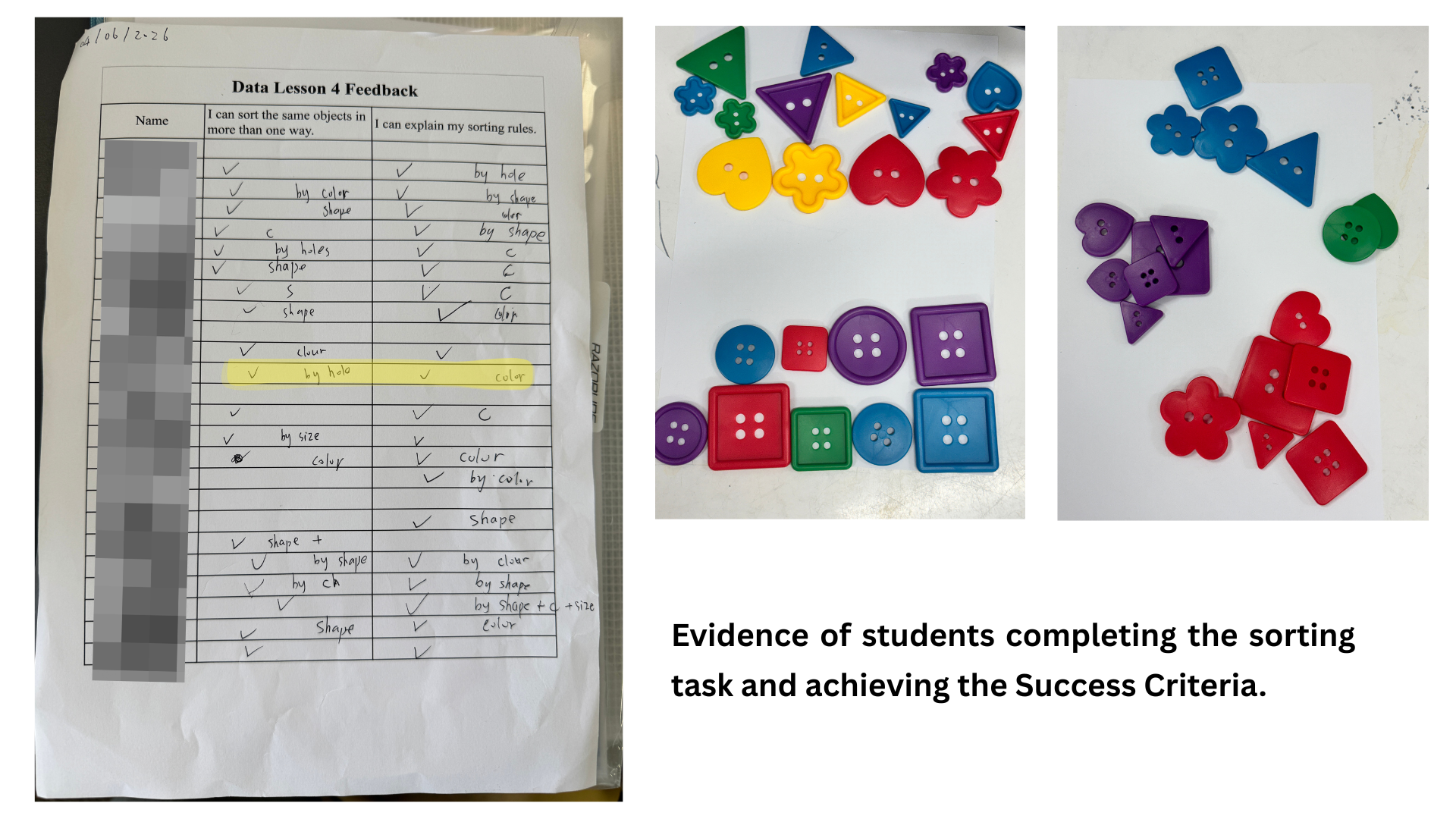
Formative assessment checklist aligned with the lesson Success Criteria.
Annotation
Observation records and student responses provided ongoing evidence of conceptual understanding and informed immediate teaching decisions.
At the end of each unit, students completed summative assessment tasks that were evaluated using agreed classroom rubrics. Before finalising achievement levels, I discussed selected student work samples and assessment decisions with my mentor teacher to ensure that judgements were consistent with the agreed Success Criteria and school expectations. Following these moderation discussions, assessment outcomes and teacher comments were shared with families through Seesaw (refer to Figure 5; APST 5.2, 5.3, 5.5).
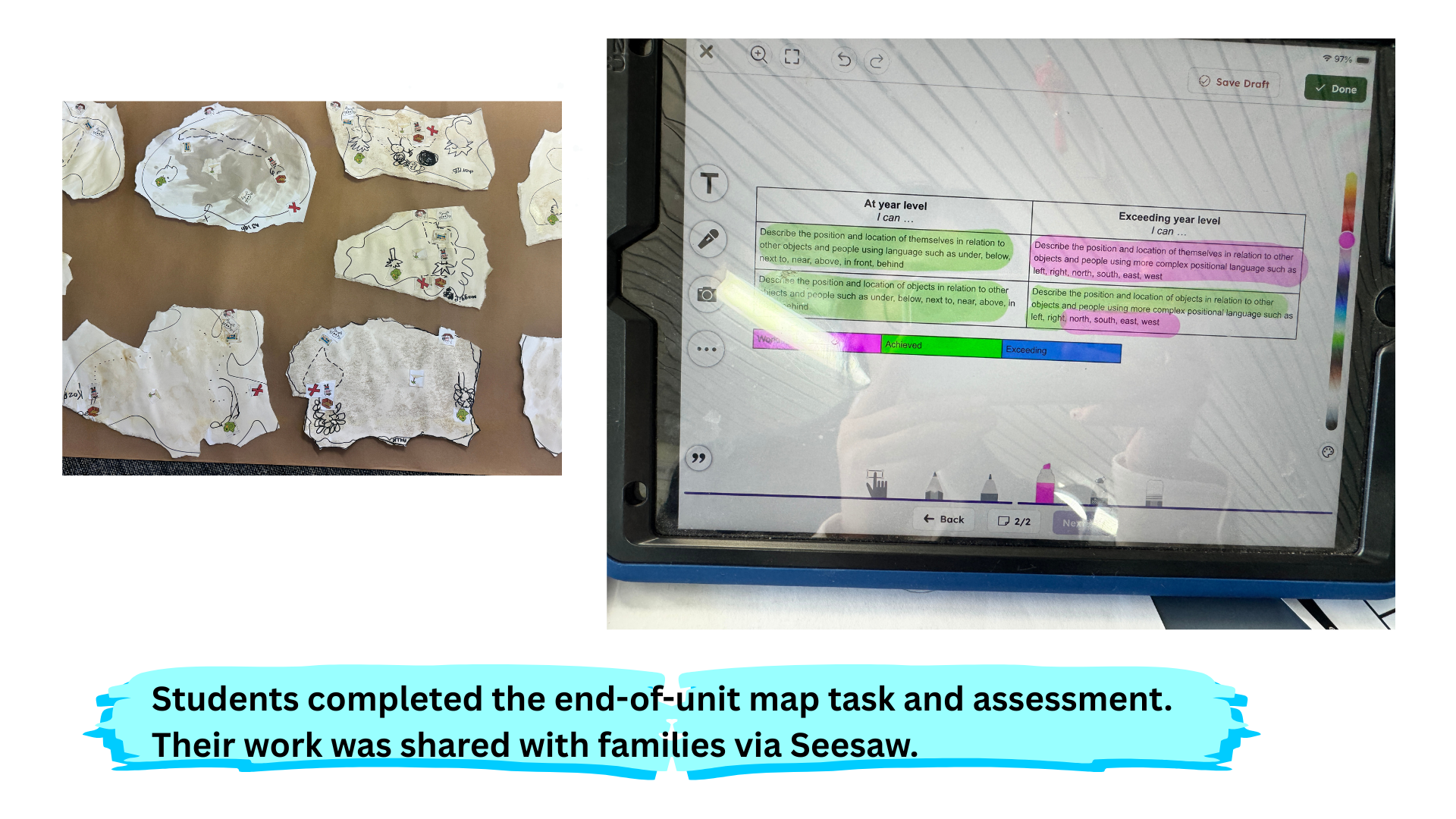
Rubric-based summative assessment and reporting through Seesaw.
Annotation
Assessment decisions were moderated collaboratively with my mentor before student achievement and teacher feedback were communicated to families through Seesaw.
Immediate feedback remained an important component of every lesson. Rather than waiting until assessment tasks were completed, I reviewed students’ work during learning and provided specific feedback linked directly to the Success Criteria. This enabled students to recognise successful strategies while understanding the next step in their learning (refer to Figure 6).
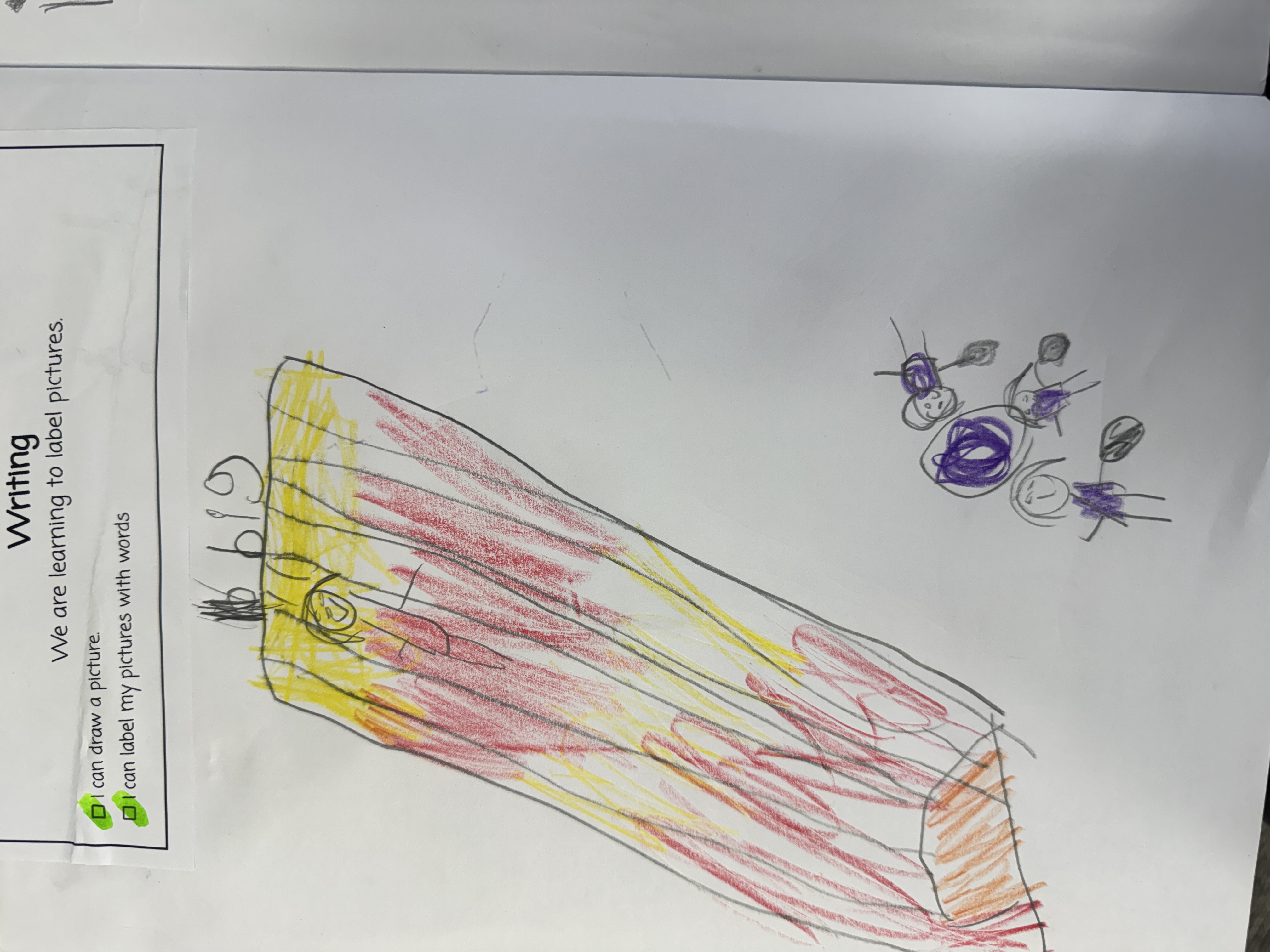
Immediate written feedback provided during the writing lesson.
Annotation
Feedback linked directly to the Success Criteria supported students to recognise current achievement and identify appropriate next steps.
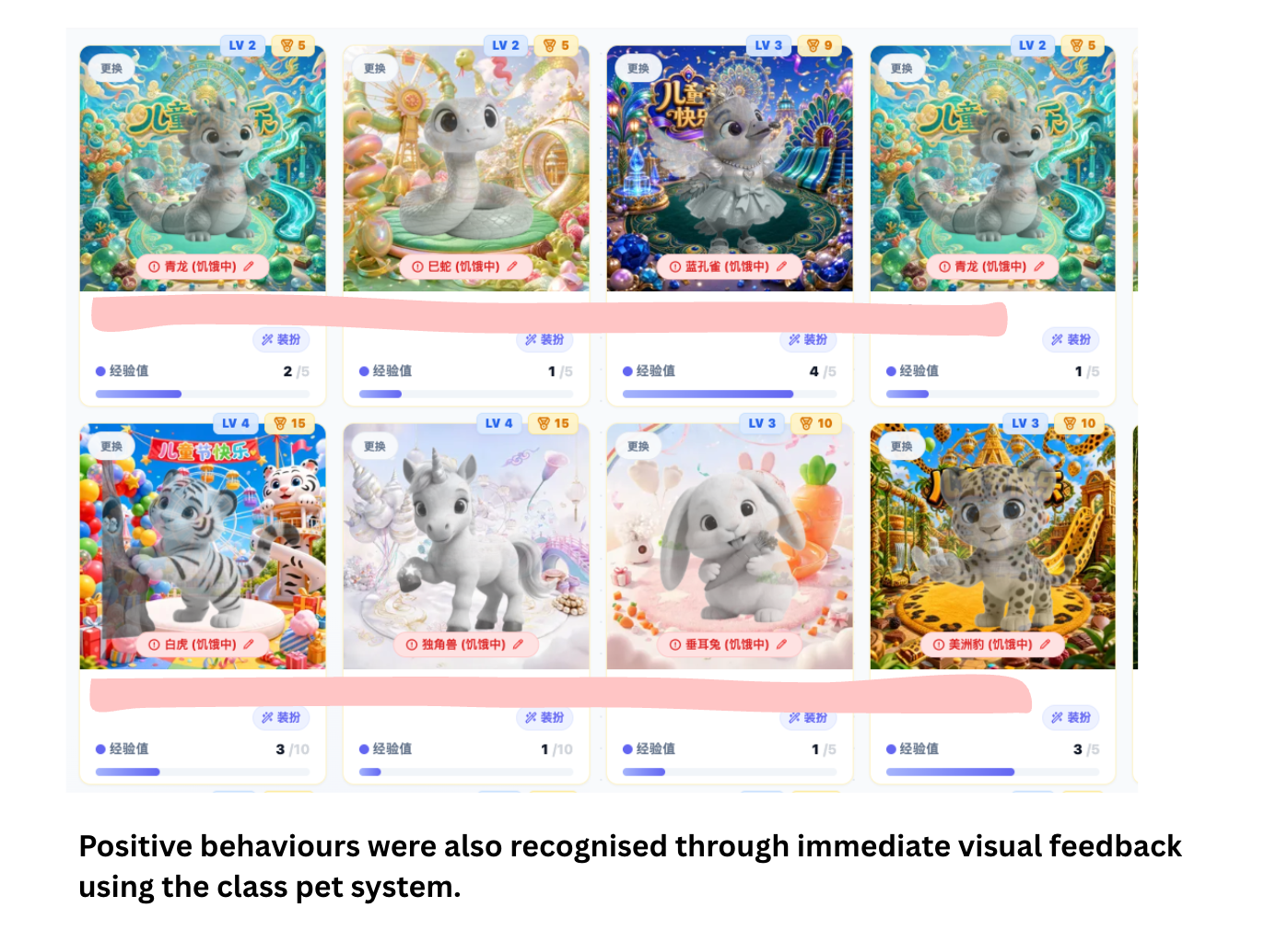
Positive learning behaviours were reinforced through timely verbal feedback and the classroom digital pet reward system. Rather than offering general praise, feedback acknowledged specific behaviours such as persistence, respectful communication, collaboration and active participation, making learning expectations visible throughout the day (refer to Figure 7; APST 4.2, 5.2).
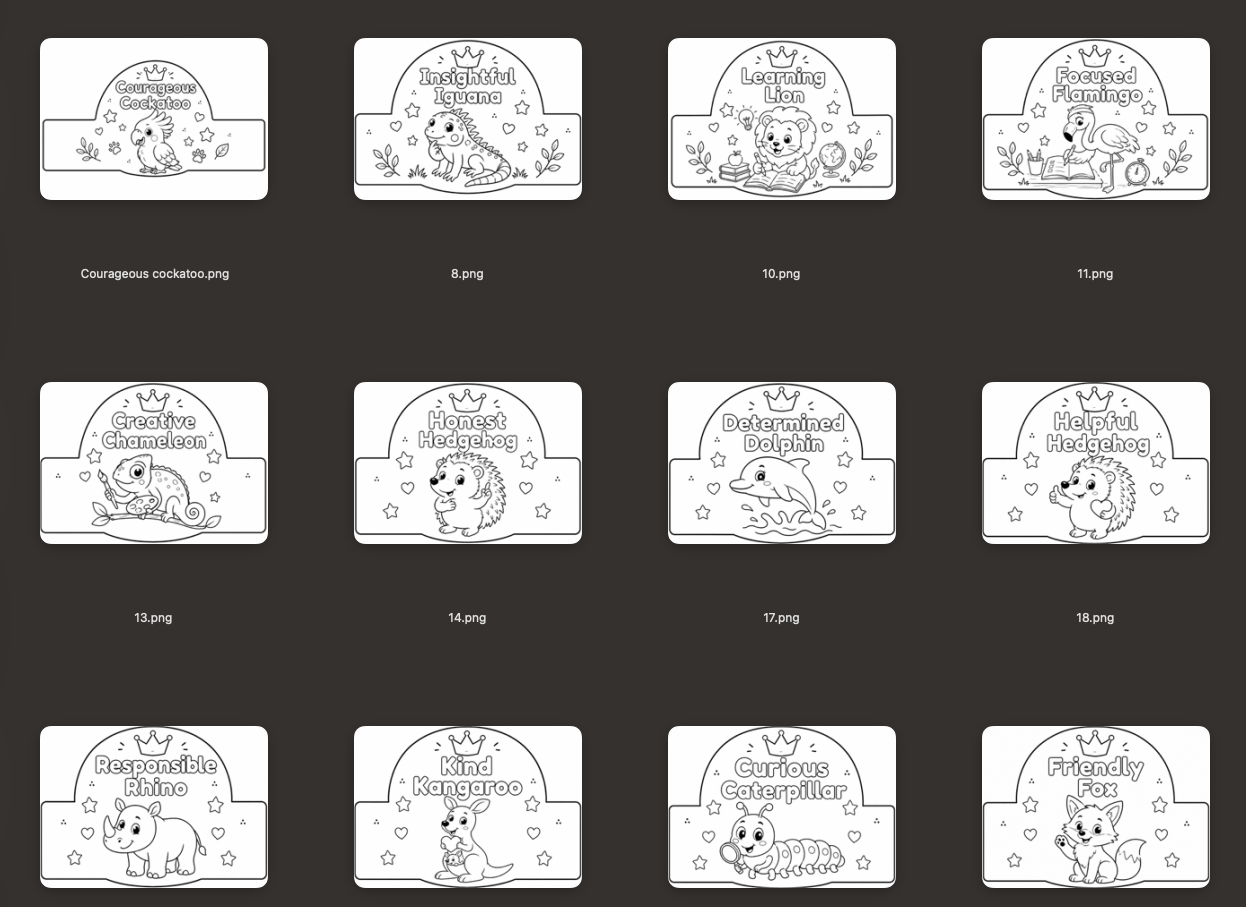
At the conclusion of my placement, I created individual animal crowns that recognised a strength each student had consistently demonstrated, such as being helpful, curious, focused or responsible. This provided a final form of strengths-based recognition without ranking students against one another (refer to Figure 8; APST 1.2, 5.2).
R — Results
Assessment became an ongoing process that informed planning, teaching and feedback rather than simply measuring learning. Students demonstrated clear progress in writing through the scaffolded sequence, while formative assessment enabled misconceptions to be identified and addressed immediately. Summative assessment and Seesaw reporting provided evidence of achievement and informed communication with families (refer to Figures 2, 4 and 5; APST 5.1, 5.2, 5.5).
Positive verbal feedback, the class pet system and individual strengths awards also promoted students’ confidence, engagement and sense of belonging (refer to Figures 7 and 8; APST 5.2).
E — Evaluation
This experience reinforced my understanding that assessment is most effective when it informs teaching rather than simply measuring learning. Using prior data, ongoing formative assessment and moderation discussions enabled me to make responsive teaching decisions and provide fair, evidence-based feedback throughout the learning cycle (Black & Wiliam, 2009; Hattie & Timperley, 2007).
S – Standards
Primary APST Focus
APST 5.1 – Assess student learning
Assessment evidence, observations, work samples and Success Criteria were used to monitor learning and inform teaching throughout the unit (refer to Figures 1–4).
APST 5.2 – Provide feedback to students on their learning
Students received timely verbal, written and visual feedback that supported both learning progress and positive learning behaviours (refer to Figures 3, 6, 7 and 8).
APST 5.3 – Make consistent and comparable judgements
Assessment decisions were moderated with my mentor using shared rubrics before results were reported to families through Seesaw (refer to Figure 5).
Supporting APST
APST 1.2 – Used assessment evidence to understand students’ learning needs and differentiate teaching (Figures 1 & 2).
APST 3.1 – Established Learning Intentions and Success Criteria aligned with assessment (Figure 3).
APST 3.2 – Sequenced writing tasks from drawing to sentence writing based on assessment evidence (Figure 2).
APST 5.4 – Interpreted assessment data to adjust teaching (Figures 1 & 4).
APST 5.5 – Reported student achievement to families through Seesaw (Figure 5).
References
Australian Government Department of Education. (2022). Belonging, Being and Becoming: The Early Years Learning Framework for Australia (Version 2.0).
Australian Institute for Teaching and School Leadership. (2017). Australian Professional Standards for Teachers.
Black, P., & Wiliam, D. (1998). Assessment and classroom learning. Assessment in Education: Principles, Policy & Practice, 5(1), 7–74.
Vygotsky, L. S. (1978). Mind in Society: The Development of Higher Psychological Processes. Harvard University Press.